Xatu: eXcitons from ATomistic calcUlations
Xatu solves the Bethe–Salpeter equation (BSE) for excitons in crystals, starting from electronic structures built on localized orbitals: tight-binding models, Wannier90 Hamiltonians, or DFT calculations with the CRYSTAL code.
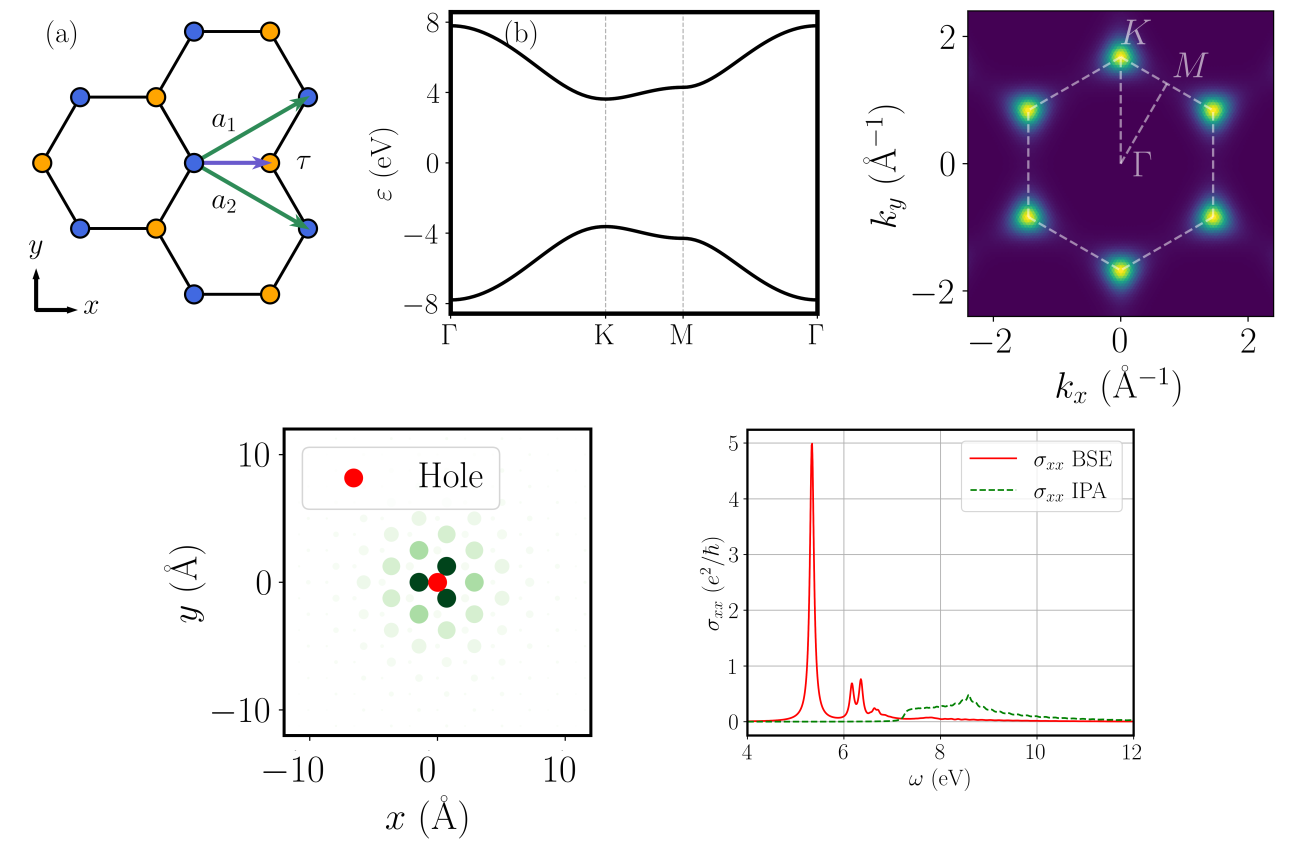
It can be used as a command-line program or as a C++ library. From the exciton spectrum it computes optical absorption, exciton wavefunctions in real and reciprocal space, spin, and the microscopic screening of 2D materials.
Reference paper
A. J. Uría-Álvarez, J. J. Esteve-Paredes, M. A. García-Blázquez and J. J. Palacios, Efficient computation of optical excitations in two-dimensional materials with the Xatu code, Computer Physics Communications 295, 109001 (2024). Please cite it if you use Xatu.
Where to start
Dependencies, building Xatu on Linux and macOS, and optional HDF5 support.
Excitons and optical absorption of monolayer hBN, from the input files to the plots, in under a second.
Every flag of the xatu binary and the common recipes.
System, exciton, screening and absorption files: every keyword, with defaults.
What each output file contains, its format and units.
The BSE, the interaction potentials and the optical conductivity as implemented in Xatu.